
In the heart of Atikokan, the spirit of our Viking ancestors flows through every paddle stroke on Saganagons Lake and echoes in the values that bind our community together. The Norse seafarers who ventured across unforgiving waters centuries ago left more than just genetic markers—they planted seeds of resilience, craftsmanship, and communal loyalty that continue to shape how we live, work, and celebrate in this northern Ontario haven.
When old-timer Harold Bjornson talks about his grandfather’s hand-carved fishing boat still resting in his boathouse, he’s sharing more than family history. He’s connecting us to a lineage of skilled boat builders who understood that survival meant respecting both the water and the wood. That same reverence lives on when local families gather for winter solstice celebrations at the community center, sharing hearty meals and stories that stretch back generations, honoring the Viking tradition of communal feasting during the darkest days.
The Viking way wasn’t about conquest alone—it centered on fierce independence balanced with unwavering community support, a philosophy perfectly suited to life in Atikokan. Our ancestors understood that thriving in harsh landscapes required neighbors who showed up when trouble struck, whether battling storms at sea or harsh Canadian winters. Today, that translates into volunteer fire departments, community fundraisers, and the unspoken rule that no one faces hardship alone. These aren’t dusty museum pieces—they’re living customs that make Atikokan distinctly ours.
The Norse Who Found Their Way North
From Fjords to Forests
When Norwegian and Swedish immigrants first glimpsed the landscape around what would become Atikokan in the late 1800s, something stirred in their hearts. The rocky Canadian Shield outcroppings jutting from the earth reminded them of the ancient bedrock back home. The countless lakes shimmering between stands of pine and spruce could have been lifted straight from the valleys of their homeland. While Atikokan might lack the dramatic ocean fjords of Norway, the deep, narrow lakes carved by glaciers thousands of years ago echo that same sense of water cutting through ancient stone.
The forests here spoke a familiar language too. Dense woodlands of evergreen and birch stretched as far as the eye could see, much like the boreal forests of Scandinavia. These newcomers understood how to read the land, how to move through thick bush, and how to respect the wilderness that could both provide and challenge.
Perhaps most importantly, they recognized the rhythm of seasons that demanded resilience. The harsh winters testing every family’s preparation, the brief explosive summers when everything grew with frantic energy, the long twilights that made you want to work until darkness finally came. This wasn’t just similar terrain; it was a place that required the same Viking spirit their ancestors had needed to survive and thrive in the North.
Old-timer Harold Bjornson once said his grandfather chose to settle here because “the rocks had the same stubbornness as the ones back in Bergen, and that felt like a sign we belonged.”
Viking Values Still Alive Today
The ‘Dugnad’ Spirit in Our Community
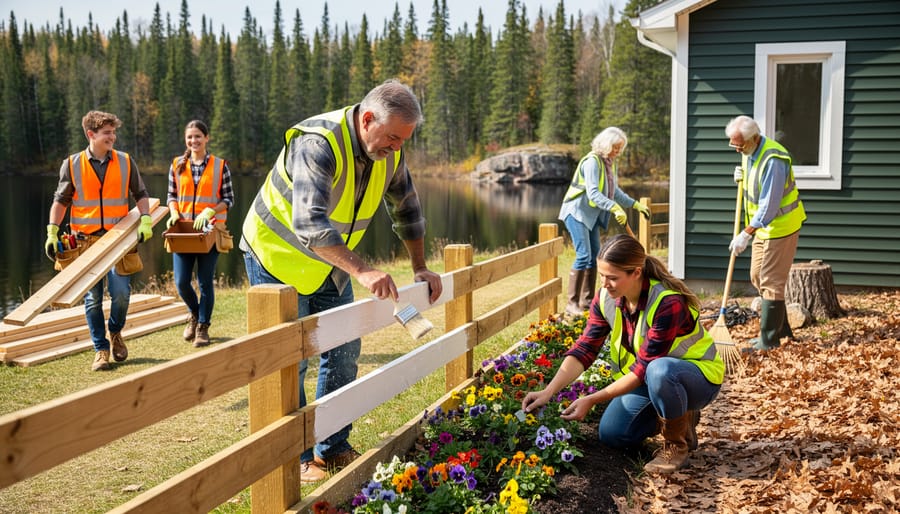
In the frozen winters of medieval Scandinavia, survival depended on neighbors helping neighbors. The Norse people developed a tradition called dugnad—a gathering where community members voluntarily worked together on projects benefiting everyone. No one kept score of who contributed what; the work simply got done because it needed doing, and everyone understood their role in the collective wellbeing.
This Viking spirit thrives today in Atikokan, though we might not always call it by its ancient name. Every spring when the ice melts, you’ll find volunteers gathering at the boat launch, clearing debris and preparing the docks for another season of fishing and exploration. Nobody receives payment. Nobody seeks recognition. They show up because the lake belongs to all of us, and caring for it is simply what neighbors do.
The tradition shines brightest during our annual Blueberry Festival preparations. Weeks before visitors arrive, residents spend evenings painting booths, setting up stages, and transforming our downtown into a celebration space. Local contractor Jim Bergstrom organizes the heavy lifting each year, but he’ll tell you he’s just coordinating what people already want to do. “We don’t need committees and formal requests,” he says. “Someone mentions the gazebo needs repair, and by weekend, there’s a crew with tools and lumber.”
The same spirit appears in quieter moments too. When elderly residents need firewood split for winter, young families arrive unannounced with axes and chainsaws. When the community center roof leaked last October, tradespeople donated materials and labor without hesitation. No invoices. No contracts. Just the understanding that we take care of each other because that’s how communities endure.
This is dugnad in action—the Viking legacy of collective responsibility living on through simple, generous acts that make Atikokan more than just a place on a map.
From Longboats to Canoes
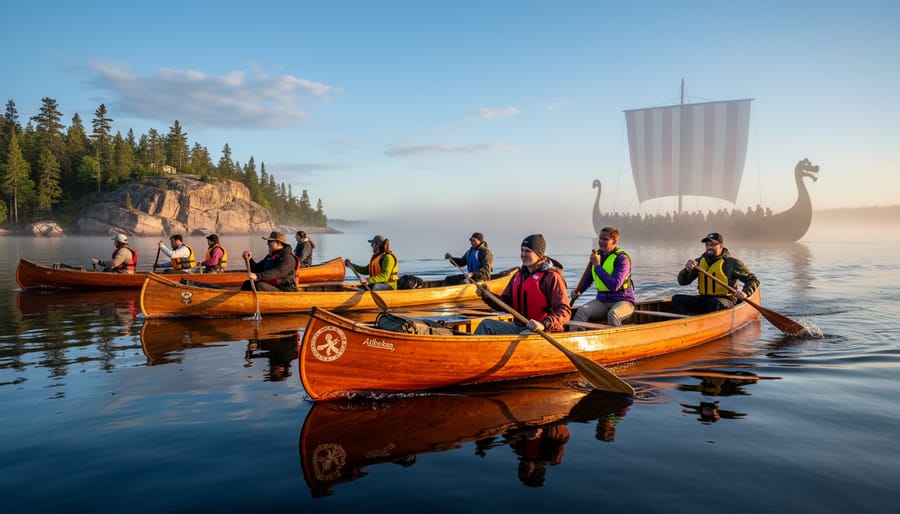
The Vikings didn’t just raid and pillage—they were the greatest seafarers of their age, masters of reading wind, water, and weather in ways that kept them alive on journeys across unforgiving seas. That intimate relationship with waterways runs deeper than most people realize, and here in Atikokan, we’ve inherited more than just stories from those Norse ancestors. We’ve carried forward that profound connection to the water itself.
When you paddle through Quetico Provincial Park or glide across one of our countless pristine lakes, you’re following in the wake of a thousand-year tradition. The Vikings navigated by reading subtle shifts in current and wave patterns, skills passed down through generations of observation and experience. Today, our local paddlers do the same thing, understanding how wind catches certain bays, where underwater rocks create telltale ripples, and which routes offer safe passage during changing conditions.
The transformation from longboats to canoes wasn’t just about geography—it was about adaptation. When Norse descendants settled in regions like ours, they encountered Indigenous peoples who had perfected their own water craft over millennia. The birchbark canoe became the vessel of choice, but that Viking spirit of exploration and respect for the water’s power never faded.
Local guide Tom Hendrickson puts it perfectly: “My grandmother used to say our people were born with paddles in their hands. Whether it was oars or paddles, we’ve always known that water isn’t something to fight—it’s something to work with, to understand, to respect.” That wisdom echoes what Viking sailors knew centuries ago.
Atikokan earning its title as the Canoeing Capital of Canada isn’t coincidence—it’s heritage. When families here teach their children to read the water, to sense approaching weather, to navigate by landmarks and instinct, they’re keeping alive skills that Vikings would recognize instantly. The vessel changed, but the soul of the journey remains the same: humans and water, working in harmony, exploring what lies beyond the next bend.
Feasts, Festivals, and Fishing Traditions
The Old Ways of Preserving the Catch
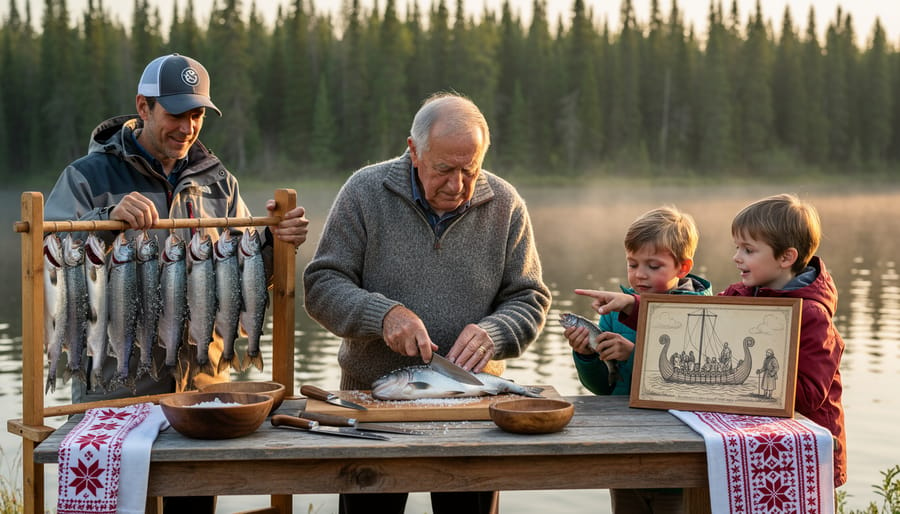
Long before refrigeration came to Ontario’s north country, the Vikings had perfected the art of preserving their catch—methods that found a natural home here in Atikokan’s fishing culture. Walk into any longtime local’s basement or garage, and you might still spot the telltale signs of these ancient techniques being practiced today.
Drying fish in the open air, a practice called wind-drying, remains surprisingly common among families who’ve been fishing Steep Rock Lake for generations. The Johnsons, who’ve lived on Third Avenue for sixty years, still hang their catch on wooden racks each summer, just as their Norwegian ancestors did centuries ago. The process is simple: clean the fish, split them lengthwise, and let the northern winds work their magic over several days. The result is a protein-rich delicacy that keeps for months and carries a concentrated, savory flavor.
Salting and smoking techniques also trace back to those seafaring ancestors. Local fisherman Dale Peterson swears by his grandfather’s cold-smoking method, learned from his own family who immigrated from Sweden. The secret, he says, is patience—letting the smoke from birch and maple work slowly into the flesh over hours.
These preservation methods aren’t just historical curiosities either. Several Atikokan restaurants feature smoked and cured fish prepared using these traditional techniques, connecting diners to both Viking heritage and the town’s deep fishing roots. It’s a delicious reminder that the old ways often prove timeless for good reason.
Stories from the Descendants
The old wooden chest in Ingrid Andersson’s living room holds more than family heirlooms. Inside, wrapped in cloth passed down through five generations, sits a hand-carved serving spoon her great-great-grandfather brought from Norway in 1892. “We still use it every Christmas Eve,” she says, carefully lifting the smooth birch piece. “It reminds us where we came from and what matters—sharing food, sharing stories, sharing life together.”
Ingrid isn’t alone in keeping these traditions alive. Throughout Atikokan, families with Scandinavian roots weave Viking-era customs into their daily lives, often without realizing how deep those connections run. Every December, the Johansson family gathers to make lefse, the Norwegian potato flatbread that sustained their ancestors through harsh winters. “My grandmother would say we’re not just making food, we’re making memories,” explains Carl Johansson, rolling the thin dough with practiced hands. “She learned from her mother, who learned from hers. It’s our way of honoring everyone who came before.”
For Lars Bergstrom, the connection runs through the water. His family has fished these lakes for four generations, using techniques remarkably similar to those Viking fishermen employed centuries ago. “My grandfather taught me to read the water, to respect it,” Lars shares, mending nets in his garage. “The Vikings understood that nature provides, but only if you work with it, not against it. That’s something we still live by here.”
The annual summer gathering at the community hall brings these traditions into full view. Tables overflow with pickled herring, smoked fish, and cloudberry jam. Children learn folk dances their ancestors performed at midsummer celebrations. “It’s not about being stuck in the past,” says Maria Eriksen, organizing the event for the tenth year. “It’s about understanding that those old values—courage, community, resilience—they’re what built Atikokan. They’re what keep us strong.”
These families don’t just preserve traditions; they adapt them. Ancient Viking recipes now feature local walleye instead of cod. Old Norse storytelling circles happen around campfires after hockey games. The spirit remains unchanged, even as the details shift to fit modern life in this northern town.
When you walk through Atikokan, you’re not stepping into a history lesson frozen behind glass. You’re experiencing Viking traditions that pulse through the heart of this community every single day. From the canoes slicing through Steep Rock Lake at dawn to the fishing boats heading out before sunrise, these customs haven’t been preserved—they’ve been lived, adapted, and passed down through countless generations.
Local resident Margaret Thornton puts it perfectly: “My grandfather taught me to navigate by the stars and read the water, just like his grandfather taught him. We don’t think of it as Viking heritage—it’s just how we do things here.” That’s the beauty of Atikokan’s connection to its Norse roots. The traditions feel as natural as breathing, woven seamlessly into modern life alongside smartphones and pickup trucks.
The community gatherings around shared meals, the deep respect for the land and water, the self-reliance that comes from living close to nature—these aren’t quaint customs trotted out for special occasions. They’re the foundation of daily life here, shaping how neighbors help each other through tough winters and celebrate together when the fish are running.
Whether you’re a longtime resident or planning your first visit, take a moment to recognize these living connections. Join a community fish fry, learn traditional boat-building techniques at the local workshops, or simply share stories around a campfire. In Atikokan, Viking heritage isn’t something we remember—it’s something we live.